Should NATO Intervene in Syria against the Islamic State?

Should NATO Intervene in Syria against the Islamic State?

Politico recently reported that NATO was considering joining the coalition fighting the Islamic States in Syria (presumably hoping that this would lead American president Donald Trump to dial back his NATO skepticism):

NATO has labeled the May 25 session a meeting, not a summit, and will hold only a dinner to minimize the chances of a Trump eruption. Leaders have been told to hold normally windy remarks to just two to four minutes to keep Trump’s attention. (“This is routine,” the NATO spokesperson said.) They are even preparing to consider a “deliverable” to Trump of having NATO officially join the U.S.-led coalition fighting the Islamic State in Syria, as Trump has said his priority is getting NATO to do more in combating terrorism. “It’s a phony deliverable to give to Trump, a Twitter deliverable,” said a former senior U.S. official, pointing out that the individual NATO member states are already members of that coalition.

I wrote a short paper two years ago for grad school exploring whether NATO should intervene in Syria against the Islamic State. Since the paper is topically relevant again, I’ve decided to post it here in full. As it was written in 2015, some of its references and analysis may be dated. I’ve lightly edited it for clarity and for publishing in a blog format (for example, I turned citations in hyperlinks, footnotes into parenthetical asides, etc.).

In it I argued against a NATO intervention. NATO is not prepared to begin another intervention that would require decade(s) of nation-building efforts and post-conflict security, in addition to the Afghanistan intervention it is still struggling to conclude. Adding a Syrian intervention to the mix would leave NATO states’ armed forces strained. NATO resources would be better applied to its traditional mission of defending Europe from Russia, a threat that’s reemerged over the past half-dozen years. Most of NATO’s member states are already a part of the U.S.-led coalition fighting the Islamic State in Syria in any case. Since the primary threat to Europe from the Islamic State is terrorism, I advocate instead for member states to increase domestic law enforcement resources to surveil potential threats, improve intelligence sharing with allies, and tighten restrictions on European travel to Syria – a step that especially requires Turkey’s cooperation.

####

Should NATO Intervene Against ISIS?

An Appraisal of the Limits and Possibilities for NATO Intervention in the Syria Conflict

May 2015

Spill-over from the four-year-old conflict in Syria threatens NATO’s European members. Turkey is the most directly affected, as skirmishes in northern Syria have occasionally affected Turkish border towns. NATO’s southeastern flank is not the only point of vulnerability. In fact, “flank” is not the right concept with which to describe the geography of the threat, particularly from ISIS (The Islamic State in Iraq and al-Sham, now calling itself simply the Islamic State). According to Europol, over five thousand citizens of European countries have traveled to fight in Syria. Their return to their countries of origin, scattered throughout Europe, brings an increased risk of terrorism and religious violence to Europe’s interior. Unlike veterans of the 1980s jihad in Afghanistan who waited for later conflicts like Bosnia to emerge before fighting again, the new generation of jihadist is encouraged to undertake their own attacks as soon as they return home. Moreover, ISIS’s success can inspire sympathizers in the West to skip traveling to Syria altogether and to execute acts of terror at home, such as an attack on a synagogue in Copenhagen earlier this year.

Since ISIS poses a security threat to NATO member countries, NATO must consider what role it can and should play in countering it. After reviewing the types of interventions NATO has undertaken since the end of the Cold War, its success in executing them, and the nature of the Syrian conflict of which ISIS is a part, it becomes clear that NATO’s role in a direct intervention should be minimal. Rather, NATO capabilities will be best used to support the countries most directly affected by the conflict, like Turkey. The main focus of counter-ISIS efforts under the NATO umbrella should be the creation of linkages with EUROPOL and other law enforcement agencies whose purview looks across the European continent, better enabling them to identify, monitor, and apprehend returning fighters.

What a NATO Intervention Looks Like

NATO interventions since the Cold War have followed three broad models. The first is coercive diplomacy, in which NATO uses air power to compel a conflict’s belligerents to accede to a political resolution constructed through intensive diplomatic efforts running in parallel to the military intervention. NATO or the UN then sends peacekeeping forces to provide post-conflict security and seeks to control post-conflict politics. The two Balkan conflicts typify this model. The second model pursues the direct destruction of the sitting government in the hostile state, followed by the construction of a new, democratic state and reformed security services more favorable to the allies’ interests. NATO’s International Security Assistance Force (ISAF) and Resolute Support missions in Afghanistan, as well the U.S. missions Operation Enduring Freedom (OEF) and Operation Freedom’s Sentinel, also in Afghanistan, follow this model. The third is the “light footprint” model, in which NATO supports a preferred belligerent with airpower and arms, but provides few or no conventional ground forces of its own. The post-conflict politics are left largely in the hands of domestic actors—there are no peacekeeping forces or high commissioners—although NATO governments may provide limited technical support through aid organizations or NGOs such as the National Democratic Institute or the National Endowment for Democracy. NATO’s intervention in Libya typifies this model.

NATO has executed these three models to various degrees of success (or lack thereof). The coercive diplomacy missions in the Balkans were the most successful, with relative stability lasting to the present. In Afghanistan, the United States succeeded in removing the Taliban from power, but NATO’s nation building mission has left much to be desired. Corruption has been an endemic problem inside the Afghan government and aid efforts have been marked by waste and poorly designed programs. Afghan police training only now seems to be getting on the right track, although the quality of police units remains uneven, management of police pay remains dogged by reports of corruption, and unsupervised, remotely located police bases have been known to abuse local populations. The situation may finally be trending in a positive direction now, with a new government led by Ashraf Ghani and the Afghan National Army taking the lead on internal security. However, it has taken over a decade of conflict, hundreds of NATO fatalities (thousands if counting American lives lost in Operation Enduring Freedom), and billions of dollars spent to reach this point of mixed results. In Libya, NATO achieved its stated goals: it protected the population of Benghazi from a potential government-led massacre and the NATO-backed rebels toppled the murderous Qaddafi regime. However, the post-conflict political situation deteriorated into a new civil war, revealing the light footprint approach’s limited ability to achieve sustainable success. Today, Libya still represents a threat to NATO’s southern flank as NATO members cast a concerned eye on the growing jihadist presence in the country and struggle to deal with refugee flows between the African continent and Europe’s Mediterranean border, which the failure of the Libyan state exacerbates and facilitates.

A Hypothetical Intervention against ISIS

Unfortunately for NATO, its most successful intervention model—coercive diplomacy—is not appropriate for dealing with ISIS. ISIS is not the kind of actor that will respond to diplomatic negotiation efforts, coerced or otherwise. Domination of the entire Muslim world is baked into its ideology, as is hatred to the point of enslavement or execution for religious minorities and even Sunni Muslims who do not accept ISIS’s violent, exclusionary ideology. Nor is ISIS responsive to “realist” incentives and motivations. A more calculating organization might have forgone beheading Western journalists and enslaving Yazidi women to avoid the negative Western military attention such brutality would bring. ISIS carried out these atrocities anyway, signaling there is no ground for sticks (and especially not carrots) with which NATO could achieve any diplomatic resolution.

The Libyan “light footprint” model might be more successful. NATO could support an anti-ISIS faction in Syria’s civil war, train and equip it, and provide air cover for its operations. The challenge is that there are no good candidates to support. The Free Syrian Army is currently working with anti-ISIS extremist groups whose ideologies should make NATO governments extremely apprehensive (for example, the Free Syrian Army is reportedly participating in the Jaish al Fatah coalitions, which include the Islamist militia Ahrar al-Sham and the terrorist-designated Al Qaeda affiliate Jabhat al-Nusra). NATO members like the United States have long and successful relationships with Kurdish militias, but supporting them to the level required to fully oust ISIS involves a number of problematic consequences. Turkey, a NATO member, would have a hard time permitting empowerment of Kurdish militias beyond current levels. Baghdad, which individual NATO members are trying to shore up through Operation Inherent Resolve, would have its own strong reservations. Iran-backed Shi’a militias are also vehemently anti-ISIS. Though their contribution to anti-ISIS efforts in Iraq might be tolerated now, formally backing them is out of the question for obvious geopolitical reasons, as well for their assured inflammation of already-high sectarian tensions. The United States is currently trying to develop its own faction of fighters with vetted backgrounds, but the program has been extremely slow to develop as American policymakers disagree on vetting procedures, especially on what level of past militant involvement to tolerate. If a Syrian fighter has survived to this point in a brutal, grinding civil war, he is most likely not as clean as Western governments would like and has most probably, if only out of necessity, at times worked with groups NATO members would deem unacceptable.

Even if NATO could somehow find a faction worthy of its support and capable of dislodging ISIS, it would face the same problem that resulted in Libya: tumultuous post-conflict politics. To make matters worse, hunting ISIS’s remnants would be a years-long process. Moreover, the various anti-ISIS factions active in the Syrian civil war have immense disagreements over how freed territory should be governed. Some are Islamist, others are more favorable to democracy, and even those that support democratic governance would not necessarily support liberal democratic governance. History suggests this period would be subject to serious infighting among the victorious anti-ISIS coalition of militias, and this fractious coalition would still have to face the Assad-led rump-state in western Syria.

What a decisive victory against ISIS requires, if NATO were to intervene directly, is an intervention more in line with ISAF’s mission in Afghanistan. The ISIS “government” would need to be dislodged and destroyed. An international security force would need to keep post-conflict order and hunt down ISIS’s remnants. In the Syrian portion of former ISIS territory—assuming the international community would rather carve out a new state than press on to defeat the Assad government and reunite all of Syria within its presently recognized borders—immense international aid would be required both to build new governing institutions and to rebuild the cities and infrastructure destroyed by the civil war.

The Iraqi portion of former ISIS territory could conceivably be returned to Baghdad, although this would incur the risk that Shi’a Iraqi militias would exact retribution on the Sunni population who supported ISIS (even though some did so out of fear). This would only increase the sense of Sunni alienation and disillusionment with Baghdad that led many Sunnis to cast their lot with ISIS in the first place. Partition of Iraq might be proposed, as could Kurdish independence or further increases in Kurdish autonomy, but these paths are fraught with their own complications. Baghdad would resist vehemently. Turkey would do all in its power to avoid an independent Kurdish state.

Even if these complications could be resolved, NATO simply does not have the resources to undertake such a massive mission in Syria now. NATO is still working hard to consolidate fragile, incremental gains in Afghanistan. In addition, the reemergence of an aggressive Russia is now the more existential threat to Europe. NATO’s mission to protect Europe is best served by focusing on the Russian threat. Inserting itself in the jihadist milieu that is eastern Syria and undertaking a potentially decade(s)-long rebuilding mission would only distract attention and divert resources from Europe’s more pressing challenge to the East.

The best kinetic solution is perhaps the one coalition forces, including many NATO members, are already enacting through Operation Inherent Resolve. In this operation, a coalition of Western and Arab states is harassing ISIS targets from the air and destroying weapons stocks, oil refineries, “government” buildings, and exposed fighters. Ideally, ground forces would clean up behind the air strikes but coalition forces are understandably unwilling to take on that burden themselves. The goal is to degrade and harass ISIS, heading off further territorial expansion and weakening its grip on the territory it now holds.

What NATO Member States Can Do

Since directly intervening against ISIS beyond individual NATO members’ current participation in Operation Inherent Resolve is not in NATO’s best interest given resource constraints and more pressing threats, NATO should instead help European states deal with the conflict’s symptoms. Chief among these is the flow of European fighters to and from the conflict and the threat of ISIS-directed or ISIS-inspired terrorism, especially from those who fought with ISIS and other jihadist groups. Such a problem is best handled by intelligence agencies and law enforcement, but NATO can lend its intelligence to the fight—particularly information on European fighters gathered by member states through their actions under Operation Inherent Resolve. Mechanisms to share relevant information gathered on European citizens who have traveled to Syria and those who have potentially returned with EU law enforcement agencies such as Europol should be established, enabling them to monitor, track, and detain potential threats. Intelligence sharing is especially important given the open borders among EU members.

Rather than ratcheting up public spending to support a Syrian intervention, NATO member states would do well to use those resources to better fund and equip domestic law enforcement agencies and surveillance capabilties. The perpetrators of recent attacks in Europe (the Charlie Hebdo attackers for example) were known to authorities and at times had been previously surveilled and even detained, but a lack of resources and manpower meant surveillance could not be maintained if the suspects went for long periods without raising additional red flags or undertaking further suspicious activity.

NATO members should also advocate for a unified policy among member states regarding citizen travel to Syria and key transit countries like Turkey. This could include banning travel to Syria with a restricted set of exceptions for aid workers, family, and other permissible travelers. Turkey can play an essential role by tightening control over access to border towns with Syria and notifying other European states when their citizens turn up in suspicious places. NATO members can provide technical assistance to Turkey to help it tighten its border security. Additionally, NATO members should pressure Turkey to reduce its support for Islamist militias in Syria (for example, leaders of the Jaish al Islam coalition are reported to have met Turkish officials in Turkey).

ISIS and the broader Syrian conflict pose real challenges to European security. However, intervening directly in the conflict is not the best use of limited NATO resources.  ISIS would not be responsive to coercive diplomacy, and a light footprint approach suffers from the lack of an appropriate faction to back. An ISAF-style intervention is the only model that could decisively eliminate ISIS, but the amount of resources, time, and lives such an intervention would cost are not commensurate with the threat ISIS poses to Europe relative to Russia, from which such an intervention would divert attention. Therefore, NATO is not the best auspices through which to address ISIS. Interested member states should instead channel their efforts through Operation Inherent Resolve. With regard to ISIS, NATO should instead contribute substantial intelligence support to NATO and EU members and take steps to shore up Turkey’s will and ability to control its border. Intelligence support will help minimize the threat posed by European fighters returning from the Syrian conflict by enabling European law enforcement agencies to better monitor, track, and apprehend returning fighters who fought with ISIS and other terrorist groups.

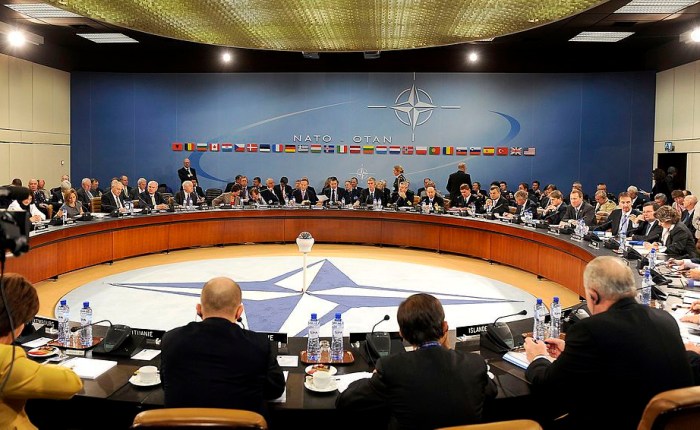
Header Photo: NATO headquarters in Brussels, Belgium, Oct. 14, 2010 (Credit: public domain)
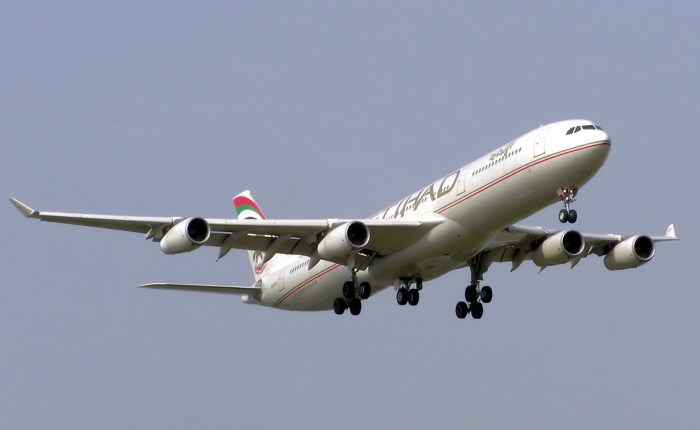
Trade Policy by Other Means: Gulf Airlines and the Electronics Ban

Trade Policy by Other Means: Gulf Airlines and the Electronics Ban

The United States and the United Kingdom both announced last month electronics bans on inbound flights from Middle Eastern countries, yet a notable difference between the orders stands out: the American ban includes airports in the United Arab Emirates and Qatar, but the UK ban does not.

The Trump administration banned carrying consumer electronics larger than a mobile phone – to include laptops and tablets – onto inbound direct flights from eight Middle Eastern and North African countries, including Jordan, Egypt, Turkey, Saudi Arabia, Morocco, Qatar, United Arab Emirates, and Kuwait. The U.S. Department of Homeland Security said the move was a response to the increased targeting of airlines and airports by terrorist groups over the past two years.

The United Kingdom issued a similar ban shortly after, but did not include the United Arab Emirates and Qatar.

While it is difficult to assess the appropriateness of measures taken in the name of national security without access to the classified information on which they may have been based, the fact that the U.K. followed suit lends credence the American concerns. Though the UK’s ban reinforces the likelihood that Washington’s decision was made for pragmatic security reasons, the difference in countries covered by the ban is not insignificant.

Why the UAE and Qatar Stand Out

The American ban uniquely applies to Doha International Airport in Qatar, Dubai International Airport in the United Arab Emirates, and Abu Dhabi International Airport in the United Arab Emirates, which are hubs for three Gulf airlines with which the United States’ three largest airlines have been in a multi-year trade dispute – Etihad (Abu Dhabi, UAE), Emirates, (Dubai, UAE), and Qatar Airways (Doha, Qatar).

The “Big Three” American airlines – United Airlines, Delta, and American Airlines – lobbied the Obama administration to review the Gulf airlines’ access rights to U.S. airports under Open Skies agreements, alleging that they benefit from unfair government subsidies that allow them to steal market share by offering better service at cheaper prices. The Gulf airlines counter that American airlines benefit from their own forms of government subsidization, including American bankruptcy protection laws (United Airlines filed for bankruptcy in 2002, Delta filed in 2005, and American Airlines filed in 2011) and public investment in airports and related infrastructure.

The inclusion of Qatar Airways, Etihad, and Emirates’ hub airports in the ban strikes at the core of these airlines’ strategic geographic advantage. Situated at the nexus of Europe and North America to the west, Africa to the south, and South Asia and East Asia to the east, these airports serve as efficient collection points facilitating global passenger flows, collecting in a central location disparate passengers traveling from one end of the world and sending them off to shared destinations on the other.

The ban dramatically inconveniences business travelers flying on Etihad, Emirates, and Qatar Airways, incentivizing them to travel on competing airlines instead. Business travelers are often expected to work while in the air, especially during long-haul flights. Now imagine a business traveler flying 14 hours without access to a laptop.

Business travelers will look elsewhere as long as this ban holds. By incentivizing business travelers to choose alternative airlines for their cross-global travel, the ban negatively impacts the Gulf airlines’ business prospects in the United States.

The ban will negatively affect the Gulf airlines’ ability to profitably conduct business in the United States. But is the ban justified on its security merits?


Security and the Gulf Airlines

One of the challenges in writing on security policy is the lack of access to national security information on which decisions may have been made. Any assessment based on publicly available information is necessarily limited for this reason – to put it simply, “you don’t know what you don’t know.”

That the UK does not include Qatar and the UAE in its ban suggests that there is at minimum a difference of opinion on the relevance of these countries to the threat these measures are meant to address. It should also be noted that the Gulf airlines and their airports take security at the last point of departure seriously, which is to be expected given their objectives of serving as major global hubs.

Of particular note, the UAE’s Abu Dhabi International Airport even has an American passport control point staffed by American Customs and Border Patrol agents inside the airport through the U.S. government’s Preclearance Program. Passengers flying to the United States from Abu Dhabi pass through American passport control and customs while in Abu Dhabi, before they even set foot in the United States. It’s worth quoting Customs and Border Patrol at length to get a full sense for what exactly this means (emphasis added):

Preclearance Overview

U.S. Customs and Border Protection (CBP) air Preclearance operations is the strategic stationing of CBP law enforcement personnel overseas to inspect travelers prior to boarding U.S.-bound flights. Through Preclearance, CBP Officers conduct the same immigration, customs, and agriculture inspections of international air travelers typically performed upon arrival in the United States before departure from foreign airports.

Today, CBP has more than 600 law enforcement officers and agriculture specialists stationed at 15 air Preclearance locations in 6 countries: Dublin and Shannon in Ireland; Aruba; Freeport and Nassau in The Bahamas; Bermuda; Abu Dhabi, United Arab Emirates; and Calgary, Toronto, Edmonton, Halifax, Montreal, Ottawa, Vancouver, and Winnipeg in Canada. CBP also staffs a Pre-inspection facility for passenger/vehicle ferry traffic to the U.S. in Victoria, Canada.

In Fiscal Year 2016, CBP personnel stationed abroad precleared 18 million travelers, representing over 15 percent of all commercial air travelers to the United States.

Preclearance Benefits

DHS firmly believes that establishing Preclearance operations in strategic locations will assist our efforts in identifying terrorists, criminals, and other national security threats prior to their boarding an aircraft bound for the United States, and is a critical step in DHS’s continued efforts to enhance national security and facilitate growing international travel and commerce.

The aviation security benefits of Preclearance are substantial because a uniformed, U.S. law enforcement officer interviews the precleared passenger before he or she boards the plane. This added security layer provides an additional opportunity to detect and stop threats as early in the process as possible.

In addition to enhancing security, Preclearance has the potential to increase capacity and create growth opportunities for airports and air carriers in the United States and abroad, while improving the passenger experience. Preclearance generates the potential for significant economic benefits for the United States and our international partners by facilitating travel through all gateways, creating an overall increase in clearance capacity, and maximizing aircraft and gate utilization. For travelers, Preclearance leads to faster connections and the ability to exit the airport immediately upon landing the United States.

Source: U.S. Customers and Border Patrol

Preclearance is explicitly designed to mitigate threats to national security, including from terrorism, before passengers depart for the United States. Passengers flying to the United States from Abu Dhabi pass through the same U.S. customs in Abu Dhabi, manned by U.S. CBP Officers, that they would receive once in the United States; they receive the same aviation security screening as they would if flying domestically in the United States:

Aviation Security Screening 

Preclearance passengers, and their carry-on and checked baggage, must undergo aviation security screening prior to entering the CBP inspection area. Aviation security screening, as part of the preclearance process, must be maintained at a level comparable with Transportation Security Administration (TSA) standards. This ensures security on U.S.-bound flights and allows passengers and their baggage to transfer to connecting flights in the United States without undergoing re-screening. Some foreign airports may already provide security screening at or near this level, but a signed Memorandum of Cooperation between TSA and the local General Civil Aviation Authority is required for preclearnance operations.

Source: Preclearance Expansion: FY2016 Guide for Prospective Applicants (CBP)

If CBP officers are on premises and the provision of aviation security screening is on par with America’s, but Abu Dhabi International Airport still does not provide sufficient screening of electronic devices, then no airport anywhere can, including in the United States.

Trade Policy by Other Means?

It is impossible to know based on publicly available information why Dubai, Abu Dhabi, and Doha are included in the American electronics ban, but not the United Kingdom’s. If the justification is that these airport’s security practices are not up to par, then at the very least Abu Dhabi’s inclusion is unusual.

It is possible the decision was driven by information that flagged the UAE and Qatar as potential threat sources. According to the Department of Homeland Security’s FAQ sheet, “DHS, in close cooperation with our intelligence community partners, selected these airports based on the current threat picture.” That’s a broad statement, but it’s possible the rationale could cover other dimensions such as the geographic origins of potential threats. For example, al Qaeda in the Arabian Peninsula attempted to route bombs hidden in printer cartridges on cargo flights through Dubai in 2010. However, that does not explain why the United Kingdom viewed the threat differently and did not include these countries.

Without knowing the information on which the electronics ban decision was based, we simply cannot confidently assess whether such a far-reaching decision was commensurate with the threat and why the UAE and Qatar were covered in the U.S. ban but not the UK’s. But given American president Donald Trump’s mercantilist trade rhetoric, his pledge in February to help American airlines in their Open Skies spat with the Gulf airlines, and the fact that Abu Dhabi already meets American aviation security standards and is staffed by U.S. CBP officers, it is not unreasonable to consider whether protectionist trade motives played a significant role.

Cover Picture: Public Domain

How Russia Outmaneuvered the United States in Syria

How Russia Outmaneuvered the United States in Syria

It seems quaint to dwell now specifically on America’s Syria policy, with the current administration casting doubt on fundamental pillars of America’s post-World War II foreign policy. But with president Donald Trump likely to cede the lead on ending the war in Syria to Russia, it’s worth reexamining how and why Washington’s influence came to be secondary to Russia’s.

While the conflict is undoubtedly complex, the reason Russia has been better able to realize its preferred outcomes is simple: Russia has in the Assad regime a faction it could reasonably prop up in direct service of Russian objectives at a cost it was willing to pay. The United States has no clear interest in Syria beyond countering the growth of terrorist groups, has defined no real objective in the civil war itself, and lacks effective ground partners unencumbered by ethnic complications (like the Kurds, who are sometimes viewed with suspicion outside of historically Kurdish regions and are opposed by Turkey) or questionable ideologies (like Salafist Islamism).


Russian Interests, Objectives, and Partners

Russia has relatively straightforward strategic interests at stake in Syria. First, the Syrian port of Tartus is home to Russia’s only naval facility in the Mediterranean (a relationship dating back to the 1970s and Bashar al-Assad’s father, Hafez al-Assad), meaning a threat to Bashar al-Assad’s regime is a concrete threat to Russia’s ability to operate in the Mediterranean. Since intervening in 2015, Russia has begun efforts to expand the Tartus facility and recently signed an agreement with the Syrian government to allow up to eleven warships to be located at the base, perhaps as part of a broader strategy to strengthen its ability to operate in the Mediterranean. Secondly, taking action in Syria gave Russia the opportunity to generate national pride at a time of economic stagnation at home, and lastly to defend and enhance its influence in the Middle East.

In pursuit of these interests, Russia’s discrete objective is to shore up the Assad government’s forces and destroy Assad’s insurgent opponents, ISIS or otherwise. Russia has a clear partner on the ground – the Assad government and the Syrian National Army, supplemented by irregular forces from Lebanese Hezbollah and Iran. Russia needed to provide military support to the existing Assad government, shore it up with training and equipment, and use its airpower and special forces to help turn the tide against the varied coalitions of insurgent groups. By supporting an existing government, weak as it is, Russia will not find itself responsible for rebuilding a state and designing a government from scratch, and will face less pressure to play a significant role in funding the country’s reconstruction. Russia intervention is further simplified by its leadership’s lack of consideration for avoiding civilian casualties and willingness to target civilian infrastructure, including medical facilities.


America Interests, Objectives, and Partners

The United States, by contrast, has a more muddled set of interests in Syria. America’s most obvious interest today is to deny a safe-haven from which terrorist groups can plan and launch attacks, especially ones that could reach the United States.

The steps required to turn this into policy are relatively clear, even if execution is complex. In Syria this meant hitting the Islamic State and like-minded groups, like Jabhat al-Nusra (which has since been re-branded as Jabhat Fateh al-Sham) with airstrikes while providing Special Operations support to factions on the ground willing to take the Islamic State head-on, a role in which Kurdish militant groups have proven most reliable and effective.

Somewhat ironically, American efforts to pursue this same counterterrorism objective in Iraq have in many ways mirrored Russia’s actions in Syria: prevent the embattled government from collapsing and slowly work to roll back anti-government insurgents by providing training and weapons to the allied government’s forces and supplement their capabilities with American airpower and special forces.

But the United States has flirted with a second objective, one tied to its interest in ending the Syrian civil war: regime change. In 2011, during the height of optimism for the Arab Spring, the Obama administration’s sympathy for Syrian protesters’ democratic demands and its revulsion at the Syrian government’s killing of civilians finally led the administration to seemingly endorse regime change. On August 18th, 2011, Obama issued a statement declaring:

The future of Syria must be determined by its people, but President Bashar al-Assad is standing in their way. His calls for dialogue and reform have rung hollow while he is imprisoning, torturing, and slaughtering his own people.  We have consistently said that President Assad must lead a democratic transition or get out of the way.  He has not led.  For the sake of the Syrian people, the time has come for President Assad to step aside.

As the civil war evolved, translating this second objective – the desire to see Assad leave – into policy is a step the United States never seemed comfortable taking, ultimately finding the lack of partners on the ground and the associated cost reconstruction costs required too much to overcome to fully commit to such a policy.

Having campaigned on the promise to end the American wars in Iraq and Afghanistan, Obama was never likely to use American troops as the primary force for unseating another government in the Middle East. Even if Obama possessed the will to commit the tens of thousands (or more) of combat troops required for such an intervention, he lacked the support of the American people. Seventy-two percent of Americans opposed sending the U.S. military to fight Assad, according to a 2015 Brookings survey. A 2013 Gallup poll found that 51% of Americans even opposed using American force simply to punish Syria for using chemical weapons.

This led to a search for Syrian rebel factions to support with arms and training to serve as a main ground force instead. But the Obama administration must have also been conscious of the lessons of the earlier Afghan war against the Soviet Union – in which hundreds of millions of dollars in American aid, matched by Arab Gulf allies, were poured into the anti-Soviet jihad, contributing to a milieu of money, war, and violent Sunni Islamist ideology from which al-Qaeda emerged by the war’s end – as the United States’ Goldilocks-like search for an effective and ideologically acceptable rebel faction turned up few good options.

Even if the United States found a suitable proxy, reluctance to bear the costs of post-Assad state building and reconstruction – the immense scope of which the United States was deeply familiar from similar efforts in Iraq and Afghanistan – was another factor weighing against an emphasis on toppling the Assad government.

Though the United States has funded assistance programs for anti-Assad rebels, as the war wore on Washington focused most of its military efforts on countering the Islamic State, which presented a more immediate threat to American interests and security as it upended the post-2011 settlement achieved in Iraq and gave aid and inspiration to individuals seeking to carry out attacks in Europe and the United States. This led Washington to instead pursue Assad’s ouster primarily through diplomatic negotiations, quixotically hoping to reach an agreement that would see Assad step down without dismantling Syria’s governing infrastructure (such as it still exists).


Trying to Square a Circle

It’s difficult to intervene in a civil war when you don’t support either side. That’s the position the United States found itself in when Russia finally threw its weight behind Assad. The United States did not favor Assad, but neither did it trust many of the strongest groups opposing him enough to throw behind them sufficient military support to tip the conflict’s balance in the rebels’ favor. Moreover, Washington was never comfortable with the state-building obligations committing to a policy of regime-change would have entailed. The United States chose instead to focus on countering the Islamic State rather than ending the civil war, and settled on supporting its longtime Kurdish partners to do so, despite the ethnic and geopolitical limitations that entailed.

Here we can again appreciate the greater clarity of Russia’s situation: Russia could clearly choose a side in the civil war. It was already allied with Syria’s existing government, whose ground forces, supplemented by Syria’s other allies in the region, could be meaningfully augmented by Russian special forces and airpower. Furthermore, with Syria representing Russia’s lone Middle Eastern ally and playing host to its only Mediterranean naval port, Russia had tangible strategic interests at stake in the civil war’s outcome.

The lack of any meaningful American threat of force against the Assad government – having prioritized the fight against the Islamic State instead – left little leverage to be used in Washington’s attempt to end the civil war through diplomatic talks. The Assad government felt no need to make concessions, and no rebel faction felt they enjoyed America’s meaningful backing. It’s this situation that Russia’s intervention upset. Russia not only tipped the conflict in Assad’s favor, but bought for itself greater leverage than the Americans in future negotiations to end the war.

The Trump administration, like Obama’s, is focused first and foremost on defeating the Islamic State. Unlike Obama, Trump appears far from conflicted about what this means for the future of Assad’s government. Trump’s words to date suggest he is more than happy to cede leadership on negotiating the civil war’s outcome to Russia if Russia cooperates with the campaign against the Islamic State, suggesting that the future of Bashar al-Assad – head of a government responsible for the torture, rape, and murder of thousands of its own citizens via barrel bombs, extrajudicial hangings, and the bombing of schools and hospitals – is for the time secure. Assad appears likely to stay, but as long as he does so will the constellation of rebel factions that oppose him, some of which the United States believes pose a significant threat to U.S. interests. While the Islamic State will eventually be dislodged from its territory, the United States will still need to sustain counterterrorism operations for some time – it just won’t have much say in the political future of the government in Damascus around which the conflict continues to revolve.

Header photo: U.S. Secretary of State John Kerry shakes hands with Foreign Minister Sergey Lavrov on October 23, 2015, at the Imperial Hotel in Vienna, Austria, before a bilateral meeting focused on Syria. [State Department photo/ Public Domain]

The Iran Deal Helped Avert a Crisis, but is the United States Prepared for What Comes Next?

The Iran Deal (or the Joint Comprehensive Plan of Action—JCPOA—as it is officially known) has now come up at both presidential debates and the only vice presidential debate. With its time in the spotlight renewed, it is worth returning to the run-up to the deal to examine how and why the United States and Iran got there. Iran’s need for a nuclear agreement is relatively straightforward given the economic impact of sanctions and the changing security dynamics of its region. While a deal could also have advantages for the United States, did it really need one the same way Iran did?

The debate surrounding an American need for a nuclear deal resurfaced in a May New York Times Magazine article, namely the assertion that the United States faced a choice between a deal or war. In my reading, this is a false dichotomy as it ignores a third, more likely outcome: nothing – Washington would take no action in response to Iran’s growing nuclear infrastructure, and Iran would slowly, eventually, acquire a nuclear capability and the world would learn to deal with it.

Neither alternative to a deal – war or a nuclear armed Iran – was preferable. Yet even with the nuclear agreement now in place, it is a mistake to think issues in the Middle East are even marginally less complicated for the United States. In effect, Washington traded a reduction in a theoretical existential threat to the United States with a low likelihood of occurring (a potential future Iranian nuclear strike on the United States) for an increase in high-likelihood conventional threats to the region (non-nuclear Iranian use of force in neighboring sovereign territory, as it has done in Lebanon, Syria, and Iraq). Though the United States has mitigated the rise of a potential nuclear power for the time being, the increase in regional conventional risk must be managed. It will not be easy.


The Iranian Case for a Deal

Iran’s case for a deal is clear given the incredible impact of international sanctions on Iran’s economy and Iran’s improving strategic position in the greater Middle East.

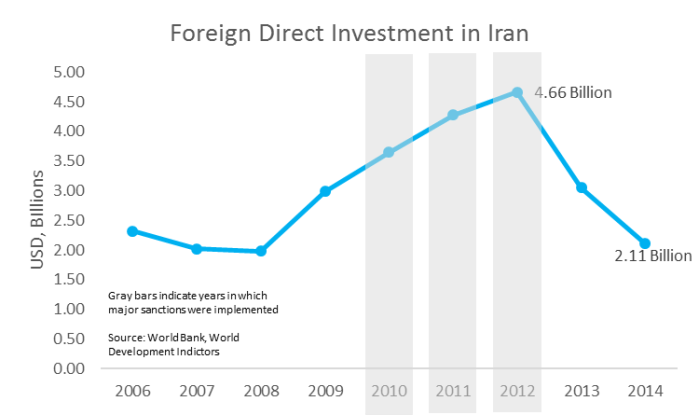
Sanctions devastated the Iranian economy after the European Union and United Nations joined the United States. in implementing more aggressive measures between 2010 and 2012. Iran’s GDP per capita fell a whopping 31 percent between 2011 and 2014, while oil exports—on which Iran’s government relies for 50-60 percent of its income—fell by nearly half during the same period. Just as critically, sanctions prevented Iran from accessing the Western technology and capital needed to modernize its ageing energy infrastructure and develop its massive, underutilized natural gas reserves (Iran is a net gas importer despite possessing one of the largest natural gas reserves in the world).

The impact of the 2010-2012 nuclear sanctions on Iran’s economy is striking when visualized. The following illustrate just how dramatically Iranian GDP, GDP per capita, and foreign direct investment were impacted:

iran-gdp-growth

Source: World Bank World Development Indicators

iran-fdi

Source: World Bank, World Development Indicators


Iran had an urgent economic need for a deal, but its changing strategic position in the region is what made giving up its nuclear program in exchange for sanctions relief palatable. The U.S. withdrawal from Iraq in 2011 and the U.S. draw-down in Afghanistan meant that, for first time in the Islamic Republic’s history, the country had no existential threat on its borders driving the need for a nuclear deterrent. Until 2003, Iran had to deter an aggressive neighbor in Saddam Hussein, who had already waged a costly war with Iran in 1980s and had proved willing to invade his neighbors (Kuwait), gas his own people with (the Kurds), and was developing a nuclear capability of his own into the 1990s.  When Hussein fell, one potential threat replaced another. With the invasion of Iraq in 2003 and the onset of the war in Afghanistan in 2001, Iran found itself wedged between American conventional forces in Iraq in the west and in Afghanistan in the east. Iran’s insecure regional position created a strong need to develop a nuclear deterrent against the possibility of conventional attack.

But with the United States now out of Iraq and slimming its presence in Afghanistan, and with Iraq’s government in Baghdad now under Iranian influence, Iran found the threat of conventional invasion dramatically reduced. Conflict in the region now revolves around funding proxies and running irregular militias, something at which Iran excels. Giving up the nuclear program and its deterrent capability became an acceptable cost.


The U.S. Case for a Deal

The United States had been content to counter Iran’s nuclear program with sanctions for much of the 2000s. Why strike a deal now? From the U.S. perspective, the case for a deal is a function of time and resources.

Stepping back into the pre-9/11 world, before Islamist terrorism became the overriding—and often only—consideration in popular discourse about threats to American security, one sees just how seriously the United States took the threat of nuclear proliferation. Official American assessments of threats to national security in the post-Cold War world placed nuclear proliferation at the top of the list. Even after 9/11, fears that rogue states or non-state actors like al Qaeda could get their hands on nukes and other weapons of mass destruction continued to feature prominently in such assessments.

Nuclear proliferation is still a real risk, even if we sometimes forget about it in a world in which al Qaeda and the self-proclaimed Islamic State dominate headlines. The greater the number of states that possess nuclear weapons, the greater the odds that one of those states might use or lose track of one. The international effort to freeze the expansion of nuclear-capable states rests on the Nuclear Non-proliferation Treaty (NPT), to which Iran is a signatory. Allowing Iran, or any member country, to break its commitments to the NPT would undermine the NPT’s effectiveness in hindering proliferation, which the United States has a strong reason to prevent. If member states were to obtain nukes without consequence, every other member would have less reason to maintain its commitment to the agreement and a greater incentive, from a national security perspective, to obtain its own weapon as a deterrent.

Limiting the number of new states acquiring nuclear weapons is key to keeping the NPT from falling apart.  But why strike a deal with Iran now?

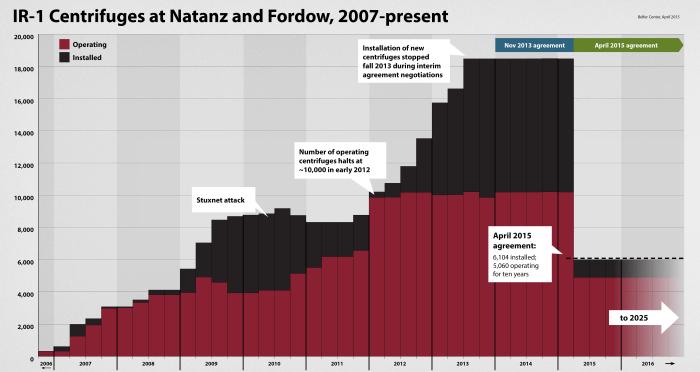
From 2006 until the interim nuclear agreement in November 2013, Iran had continuously installed new centrifuges for uranium enrichment—this despite American sanctions. By the time the interim deal was signed in 2013, most estimates pegged Iran’s breakout time between six weeks to two months. This means that Iran had installed enough centrifuges to, if it decided to go all-out and enrich uranium as quickly as its infrastructure would allow, without regard for secrecy, it would enrich half enough enriched uranium for a nuclear weapon in as a little as a month and a half. This does not mean Iran could create an actual nuclear weapon in six weeks (that still requires developing technology for the warhead itself, the delivery system, and other components), but it is a critical milestone.

ir-1-cenrifuges-at-natanz-and-fordow-2007-present-2

The above graphic from the Belfer Center illustrates Iran’s continuous installation of centrifuges, the limits the JCPOA would impose on it (source: Belfer Center)

Iran narrowing the gap between potentially having enough material for a nuclear weapon and having it in reality is what pushed the United States to act. In a sense, the United States needed the deal because it addressed an essential security concern—nuclear proliferation—that demanded an immediate answer. The pressure to do something about Iran came to a head during 2012, a year that generated headlines like “The choice: should the US and Israel bomb Iran?” (Telegraph), “Time to Attack Iran” (Foreign Affairs), and “Twenty reasons not to attack Iran” (Reuters). But is the deal—this deal—the only way to prevent a nuclear Iran? A range of alternative measures were suggested, from the diplomatic to the kinetic.

Some critics simply suggested a “better” deal as one alternative, by which they mean a deal in which Iran gives up more (e.g. dismantles rather than repurposes certain infrastructure, an agreement term longer than ten years, etc.) and the United States gives up less (e.g. retaining sanctions on certain entities or an easier process to challenge Iran if they are suspected of cheating).

A new deal was likely impossible. We tend to forget that foreign governments must answer to their domestic constituencies, too, and Hassan Rouhani’s administration has invested a huge amount of political capital in the deal, fending off opposition politicians to push the deal forward. It is likely Rouhani would be unable to sustain his defense against those trying to sabotage diplomacy with the United States if forced to start again from scratch.

For perspective on the tough road Rouhani would face if the deal collapsed, recall that two previous presidents had already attempted outreach to the United States and failed. Akbar Hashemi Rafsanjani (1989-1997) was a conservative pragmatist who in 1995 awarded the first Iranian oil contract to an American firm (Conoco, worth over $1 billion. President Clinton responded by banning investment in Iran’s oil sector and instituting new sanctions. The reformist upstart Mohammad Khatami (1997-2005), who upset the regime-favorite Nateq al-Nuri in the 1997 presidential elections, called for dialogue with America in a 1998 CNN interview, cooperated with the United States against the Taliban in Afghanistan after 9/11, and later offered to put the nuclear program on the negotiating table. But the Bush White House named Iran to the “Axis of Evil” in 2002, a public embarrassment to Khatami and his reformist movement. The conservative Mahmoud Ahmadinejad won Iran’s next presidential election; he is coincidently the only Iranian president since the death of Ayatollah Ruhollah Khomeini in 1989 to not attempt outreach to the United States.

Rouhani attempted outreach to the United States despite his predecessors’ failures attempting the same. It is highly unlikely he would have been able to start talks again if the deal failed, much less start brand new negotiations from scratch while giving up even more to the United States, as the deal’s American critics suggest.

Moreover, the United States faced the real risk that the sanctions regime weighing on Iran might crumble. The added weight of European Union and United Nations sanctions are what helped bring Iran to the negotiating table.  The most recent sanctions have succeeded because they included three of Iran’s most important trading partners: Russia, China, and the European Union.  Russia and China were key votes in favor of the suffocating UN sanctions enacted against Iran’s financial sector in 2010. In 2012 the EU banned the import of Iranian oil and levied sanctions against Iran’s central bank (the EU was the world’s largest importer of Iranian oil prior to the ban). If the talks these sanctions brought about failed, there was little reason to think Russia, China, and the EU would have the patience to continue enforcing them European businessmen started rushing back to Tehran as early as August 2015, and China was already offering “barter” deals for Iranian oil to circumvent sanction’s targeting Iran’s participation in the international banking system.

Waning European and Chinese tolerance for sanctions on badly-needed Iranian energy would leave the United States standing alone, trying to convince Iran to come back to the negotiating table as the regions that actually have influence over the Iranian economy—Europe and Asia—happily restored trade ties. The sanctions levied by the international community were essential to bringing Iran to the negotiating table, but those same sanctions effectively put an expiration date on the American opportunity to act.

How else could the United States deal with Iran in the absence of a new deal? Without a deal, Iran would resume building centrifuges and continue to narrow its breakout time until the window for action became so slim that the only remaining option to prevent Iran from acquiring enough nuclear material for a bomb was a destructive attack on Iran’s nuclear infrastructure.

To deny Iran the nuclear infrastructure for a nuclear weapon through airstrikes, the United States would need to commit to years of regular operations. Recent assessments suggest airstrikes would only set Iran’s nuclear program back by one or two years, and with each successive strike Iran’s resolve to develop a nuclear weapon would only strengthen and the prospects for a diplomatic solution more remote.

The only way to make absolutely certain Iran did not develop a nuclear weapon would require not just airstrikes, but more comprehensive combat operations attacking Iran’s broader infrastructure network – something that would destroy Iran’s existing nuclear infrastructure as well as its near-term potential to re-build. The odds of this president—or any future one—preemptively attacking Iran on such a scale are remote.

More likely, with diplomacy exhausted and military action as the only option, the United States would reluctantly accept the fait accompli of a nuclear Iran and begin efforts to contain it. This is the true consequence of no deal with Iran. The choice was not “deal or war,” but rather “deal or acceptance.”

Does all this mean the United States needed the deal as badly as Iran? The failure to reach a peacetime negotiated solution would have put the United States in a tough spot: accept a nuclear Iran and watch the NPT and the international nonproliferation regime slowly unravel, making the entire world more dangerous, or go to war. This deal, if it proves effective, certainly saves the United States a lot of trouble. On balance then, the nuclear deal makes sense.

There are caveats, of course. The deal limits Iran’s nuclear program for only 10-15 years and its success depends on effective monitoring and the resolve to punish cheating. The Harvard Belfer Center for Science in International Affairs nicely summarizes the deal’s potential and its limits:

If Iran complies, the JCPOA buys at least 10 to 15 years before Tehran can significantly expand its nuclear capabilities. If Iran cheats during this period, JCPOA monitoring and national intelligence are likely to detect major violations, which would enhance U.S. and international options to intensify sanctions and take military action if necessary. If the agreement survives after 15 years, Iran will be able to expand its nuclear program to create more practical overt and covert nuclear weapons options. There are different views on whether the JCPOA will create conditions that help to reduce Iran’s incentives to pursue nuclear weapons in the long term.

The deal will only be as strong as the IAEA inspections and the ability of the U.S. intelligence community to monitor Iran’s adherence. It will only be as strong as the United States’ ability and willingness to enforce consequences for cheating. But gathering intelligence on Iran will be all the easier with the eyes on the ground the deal provides for. Reacting to potential cheating will only be easier with the one-year breakout time created by the deal, compared to the world of no deal in which the U.S. only has two months to both detect a breakout attempt and organize an effective response.


Looking Forward

There is little doubt that reducing sanctions and perhaps eventually normalizing Iran’s international standing enhances Iran’s strategic position. In signing the JCPOA, the Obama administration is making a calculated trade-off: exchanging a reduction in existential risk for an increase in conventional risk. The deal reduces Iran’s ability to become a nuclear power while enhancing its ability to exercise conventional power.

The pause on Iran’s nuclear program and its reduction of the existential risk embodied in a nuclear weapon is the only merit upon which to judge the JCPOA. Any other argument related to Iran’s approach to wielding conventional military and economic influence – that the agreement will nudge the Iranian government to moderate over time, that more economic connectedness reduces the likelihood of war, that the deal is the cornerstone of a transformation of Middle Eastern geopolitics in favor of peace and stability – is misguided. A talented rhetorician could make a case for these, but these are cases built on hopes pinned to an optimistic interpretation of the deal’s possible second- and third-order ripple effects. Iran has only made nuclear commitments. Any other argument for the deal is nice but irrelevant in an assessment of its merits.

The existential-conventional trade-off makes sense for the United States, which can only be threatened in any material sense by Iran if Iran is nuclear armed. But the United States has allies in the Middle East who will face the consequences of an Iran with increased space for conventional action, leading to mismatched assessments of the deal’s impact on regional security. The Obama administration seems ill prepared for this reality.

The ongoing war in Yemen is a great example of the environment of elevated conventional risk in the Middle East and how the Iran deal complicates America’s diplomatic relationships in the region.

In the spring of 2015 a coalition of mostly Arab states led by Saudi Arabia and featuring significant contribution from the United Arab Emirates intervened in Yemen after an insurgent faction, whom the Saudis and Emiratis claim is an Iranian proxy, took over the government. The United States has provided the intervention with intelligence, munitions, and logistical support. Now a year and half old, the war has created a humanitarian disaster while making only minimal progress toward the coalition’s political goal of restoring Yemen’s former government.

Why exactly did the United States find itself supporting a Gulf Arab war that has achieved little, at immense human cost, and has no direct bearing on American national security? Likely because the Obama administration underestimated just how threatened the Gulf states felt by the Iran nuclear deal. With the nuclear deal trending toward completion, the desire to demonstrate resolve in the face of perceived Iranian expansionism in the Arabian Peninsula was a major factor in the Saudi and Emirati decision to go to war. Obama likely threw America’s support behind the war in Yemen because he felt the need to concretely reassure America’s Gulf allies that Washington is still seriously committed to Gulf Arab security despite his administration’s outreach to Tehran.

As the war in Yemen intensified in early 2015, a State Department official told Politico that “you can dwell on Yemen, or you can recognize that we’re one agreement away from a game-changing, legacy-setting nuclear accord on Iran that tackles what everyone agrees is the biggest threat to the region.”

This statement highlights the gap between Washington and some of its Gulf allies; it demonstrates a failure to appreciate that for Iran’s immediate neighbors the deal hardly lessens the conventional threat Iran is perceived to represent and, pinned to a misplaced hope that the deal will lessen Iran’s role in non-nuclear conflicts, suggests a lack of planning for how to mitigate negative reaction to the deal.


First Step to Getting out of the Middle East Quagmire?

Some analysts have argued that the Iran deal is part of a broader Obama administration effort to shift American foreign policy energy and resources away from quagmires in the Middle East toward engagement with rising powers in Asia, taking a “long view” of how power is shifting in the world geopolitically.

Perhaps contrary to the administration’s hopes, the JCPOA does not free the United States from Middle Eastern entanglement – not if the United States hopes to help mitigate the deal’s potential conventional consequences. The United States must remain intimately engaged in the region, not just to monitor Iranian compliance with the JCPOA but also to manage the increased risk of conventional war emanating either from an emboldened Iran or from the defensive reactions of America’s traditional Gulf allies. This does not mean the United States must take part in every flare-up, but intensive diplomatic engagement is required if the United States wishes to prevent conventional conflict.

With the JCPOA in effect, the hard part begins. The United States now has ten years to ensure that the end of the deal’s term does not simply reset the world the tense state of 2012, with Iran once again on the cusp of obtaining enough weapons-grade nuclear material for a bomb. Iran’s potential re-integration into the formal international economy will only complicate matters, increasing Iran’s capacity for conventional conflict in the Middle East at a time of great regional volatility. Is the United States prepared to manage what comes next?

Are Gulf Airlines Destroying U.S. Aviation? The PR Battle in a Trade Spat Heats Up

The PR conflict between Gulf-based airlines Qatar Airways, Emirates, and Etihad, and the three biggest American airlines is heating up. For those of you who are just catching up, the three largest U.S. carriers—Delta, United, and American Airlines—formed a lobbying group called the Partnership for Fair and Open Skies (the Partnership) and earlier this year filed a complaint to the U.S. government accusing the three Gulf carriers of violating their Open Skies agreements, which allow foreign airlines to land in the U.S., by receiving unfair subsidies from their government owners and investors. The Delta-United-American alliance wants the Obama administration to renegotiate the Gulf carriers’ Open Skies agreements to limit the allegedly subsidized “excess” passenger capacity they have been delivering to the United States.

The Gulf carriers are much younger than the American legacy carriers but are starting to eat into the American carriers’ international market share, particularly on routes to the Indian subcontinent, by offering better service at lower prices. The Partnership claims this is only possible because of their alleged government subsidies.

In the latest round, a report apparently sponsored by the Partnership claims that the demise of the U.S. shipbuilding industry offers a cautionary tale for how foreign subsidies could kill the American aviation industry:

“The end of a level playing field in aviation, with U.S. companies facing direct competition from subsidized foreign carriers, is remarkably similar to what happened to U.S. shipbuilders in the 1980s. If these foreign carriers are indeed successful in shifting traffic from American companies to their own, then American aviation will suffer…If this foreign, subsidized capacity remain unregulated, the U.S. aviation industry will be decimated by a loss of almost 200,000 jobs.”

Two immediate problems with the report’s comparison of the U.S. aviation industry to the demise of American shipbuilding jump out at me. First, the Gulf carriers are among the largest purchasers of Boeing’s passenger aircraft. In 2014, Emirates placed a $56 billion order for a whopping 150 Boeing 777Xs. Qatar Airways also bought 50 777Xs last year and added 14 more 777s this year. Etihad snapped up 25 777Xs in 2013 and, as of 2014, had also ordered 71 of Boeing’s 787 Dreamliners. One of the Partnership’s claims is that government subsidies have helped Gulf carriers buy massive fleets of modern aircraft in a way private American companies would not or could not be able to finance themselves. Taking this assertion at face value, I fail to see how this would lead to the demise of the U.S. aviation industry, which would include American aircraft manufactures like Boeing, a la American shipbuilding in the 1980s. Certainly it would suggest the opposite.

Perhaps the author meant to limit the aviation industry comparison to just American air carriers, rather than the “apples-to-apples” comparison of shipbuilding to aircraft manufacturing. Even still, the argument does not hold. The second problem is that, even if the three legacy American carriers lose significant international market share to foreign competitors, they will hardly be put out of business. American airlines have the exclusive right to service the American domestic market. This domestic market will never go away and will never be the provenance of a foreign carrier, Gulf or otherwise. Foreign air carriers are not and legally cannot be substitutes for American carriers on the domestic market the same way a foreign-built ship could substitute for an American-built ship. The only logical comparison, in which the American product and foreign products actually are substitutes on the domestic market, is aircraft manufacture. Chicago-based Boeing is in a cushy position, locked in a duopoly with France’s Airbus for the global passenger jet market (no disrespect to our Canadian and Brazilian friends at Bombardier and Embraer). The American aviation industry will be alright.

Furthermore, the American carriers’ international routes to Europe are rather secure. Through a mechanism known as “immunization,” the U.S. Department of Trade is able to grant immunity from U.S. anti-trust laws to members of international airline alliances. The American carriers and their European counterparts (Delta and Air France-KLM in the SkyTeam alliance; United and Lufthansa in the Star Alliance; and American Airlines and British Airways in the OneWorld Alliance) have used this law to legally limit competition on transatlantic routes (which, by the way, has led to a significant increase in ticket prices compared to routes with more independent competition, according to a study by the U.S. Department of Justice). In any case, a third country airline cannot fly revenue-generating passenger routes connecting European and American cities (or any two other countries’ cities for that matter) except for routes where the European city lies as a waypoint between the third country and the American city, in which case all three countries must negotiate in order for the American and European parties to grant the third country airline the exception.

The U.S. domestic market and the transatlantic European markets are essentially locked in. In effect, the real threat from the Gulf airlines is in the market for passengers from fast-growing emerging markets, especially the Indian subcontinent. It is understandable that the U.S. carriers would be frustrated by their Gulf competitors’ ability to use government financing at extremely favorable terms to purchase new aircraft, expand their capacity on routes connecting India to the U.S. via their hubs in the Gulf and, in doing so, drive down prices and margins on those routes. But this hardly signals the “demise” of the American aviation industry, and analysts like Aaron Klein, the author of the study and a director at the Bipartisan Policy Center, should know better.

The alarmist tone of this and other Partnership research does not help its case. American travelers already sense that the Gulf carriers provide better customer service and a better flying experience at a lower price. If these Gulf carriers’ gains are unfairly earned, hyperbole and exaggeration will hardly help convince frustrated, budget-conscious, and quality-conscious American travelers to care.

**

NOTE: Over the past few days I’ve been digging into the Partnership’s white paper and the Gulf airlines’ responses, trying to see who has a better case. I intend to publish an analysis of what I find in the coming week. I also intend to be more prolific with my writing here (inshallah).

Misreading the Saudi War in Yemen

Two months ago J.M. Berger wrote an article on ForeignPolicy.com taking a seemingly fresh perspective on events in Yemen: that an attack claimed by ISIS on two mosques associated with the Houthis may be the Middle East’s “Franz Ferdinand” moment, sparking region-wide war. I normally wouldn’t go out of my way to analyze an article most people probably don’t remember, but I’ll make an exception for two reasons. First, Berger is highly respected in his field, and rightly so. He has done cutting-edge work analyzing terrorists’ use of social networks for propaganda and recently co-authored a well-received book on ISIS. His words deservedly carry weight and so should be critiqued when off the mark. Secondly, his analysis reflects one of pitfalls in using historical analogy to help understand current events. Though the ISIS attacks on Houthi mosques in Yemen resembles similar sectarian attacks at the beginning of Iraq’s sectarian civil war, their significance to Saudi Arabia’s intervention in the conflict is minimal. Rather than explaining the chain of events that got Riyadh to start a war, the real significance of the ISIS attacks is their reinforcement of our understanding of how the group instrumentalizes sectarianism to expand its influence.

A Curious Analogy

So what exactly does Berger argue? In his view, the ISIS-claimed attacks sparked the Saudi-led intervention in Yemen. By bombing two mosques frequented by Houthis, who claimed control of Yemen’s government in January this year, ISIS induced the Houthis to march southward toward Aden, the seat of ousted president Abd Rabbuh Manur Hadi’s resistance at the time. The Houthis’ southern march in turn led Saudi to intervene militarily in coalition with a number of Muslim states from across the Middle East and Africa to reinstate Hadi. In Berger’s words, “[i]t’s getting hard to escape the feeling that the Sanaa bombing might be the Middle East’s “assassination of Archduke Franz Ferdinand” moment…”

Berger’s reading of the mosque bombings in Yemen parallels the consensus understanding of how the sectarian civil war in Iraq began. In 2006, Abu Musab al-Zarqawi, who led al Qaeda in Iraq at the time (the precursor to ISIS), directed the bombing of the al-Askari mosque and shrine complex, one of the holiest Shi’i sites in the country and resting place of two of Twelver Shi’ism’s Imams. Zarqawi targeted the complex in a deliberate and successful attempt to encourage sectarian civil war. If any attack screams Franz Ferdinand moment for spiraling sectarian conflict in the Middle East, it was that one.

Similarly, ISIS may very well have intended to spark sectarian war in Yemen, but Berger overstates the mosque bombings’ role in the Saudi intervention. Riyadh had ample reason to intervene in Yemen before the Houthi march on Aden—namely to reassert its influence in Yemeni political affairs and to counter perceived Iranian encroachment. Both of these objectives have long been features of Saudi foreign policy, and growing setbacks to both policy objectives in recent years were sufficient causes for Saudi intervention.

So what should we make of the ISIS bombings? As far as the Saudi intervention is concerned, the bombings are rather minor. The Saudis would not have permitted the absence of government in Yemen for long, and the Houthi march to Aden was not the straw that broke the camel’s back—Houthi control of Sana’a was bad enough in Riyadh’s eyes. Pressure on Riyadhs’s twin goals of renewing influence over Yemeni politics and countering Iran’s perceived ambitions in the peninsula had been growing for years and culminated with the fall of Hadi’s government—which was put in place by the Saudi-dominated GCC in 2012—to the Houthis. This was enough to drive Saudi to intervention; Riyadh did not need the Houthi march on Aden, precipitated by an ISIS attack on Houthi-affiliated mosques, to force its hand.

Riyadh’s Policies toward Yemen and the Region

Saudi Arabia’s intervention is firstly a calculated step to reassert its dominance over its perceived sphere of influence in Yemen. Riyadh has attempted to influence Yemeni domestic politics for all of Yemen’s modern history, beginning with Yemen’s 1962-1970 civil war. In that war, Saudi Arabia backed supporters of the ousted Zaydi Imam against a successful military coup backed by Egypt. This was part of its effort to defend conservative Arab monarchies against the rising tide of socialist Arab nationalism. Riyadh failed to reinstate the Zaydi monarchy but it did maintain extensive monetary relationships with the lay Zaydi tribesmen of Yemen’s north, who were politically empowered in the new “republican” government that replaced the Imamate controlled by the Zaydi elite. By the 2000s, however, Riyadh’s influence had diminished and had “left its Yemeni contacts to whither.” Upheaval in Yemen since 2011 has surely made Saudi Arabia anxious for stability below its southern border, and its present intervention is an attempt by the new king to re-impose a government that is favorable to Saudi interests.

Secondly, Saudi Arabia’s intervention comes in the context of its regional cold war with Iran. Not only does Riyadh feel that it has lost control over Yemen; it feels that it has lost control to its biggest rival. While the Houthis are far from Tehran’s puppets (though I’m sure they willingly take whatever support Tehran offers), what is important is Riyadh’s perception that they are in fact a conduit for Iranian influence in the Arabian Peninsula. Yemen’s importance to Saudi Arabia is similar to Ukraine’s importance to Russia: Riyadh would no sooner allow Yemen to come under Iranian control than Russia’s Vladimir Putin would allow Ukraine to join NATO.

Like Franz Ferdinand…if World War I had Already Started

The very concept of comparing the ISIS attacks to the assassination of Franz Ferdinand is odd since the Middle East was already in the midst of regional war when Saudi Arabia intervened in Yemen. Saudi Arabia and its Sunni Arab allies have been working to militarily confront Iranian involvement in Syria since 2011, and the intervention in Yemen is an extension of Saudi’s efforts to counter Iranian influence throughout the region. The alleged ISIS mosque attacks in Yemen come in the context of an ongoing regional conflict, and so do not constitute the unique war-starting “Franz Ferdinand moment” Berger makes them out to be.

Answering the Wrong Question

Berger singles out the ISIS attack on Houthi mosques as a uniquely important event, different in quality from the hundreds of other attacks and assassinations in Yemen since 2011. He is correct, but he singles it out in answer to the wrong question. The attacks do not explain why Saudi intervened. Rather, they give insight into ISIS’s strategy for expansion outside of Syria and Iraq. Berger himself notes:

“…in Yemen, it is not safe to assume that the al Qaeda splinter group and self-proclaimed caliphate [ISIS] is merely pursuing a campaign of random or purely opportunistic terrorist attacks. Instead, we should examine the consequences of its actions outside of Iraq and Syria: The group is seeking to escalate internal and regional tensions among its most dangerous foes, believing that if its provocations result in a full-blown regional war, it will thrive in the chaos.”

We can already see this strategy playing out inside Saudi Arabia. An ISIS-affiliated social media account claimed responsibility for the May 22nd bombing of a mosque in the Shi’a city of Qatif. A week later, ISIS claimed responsibility for bombing another Shi’a mosque in Saudi Arabia, this time in Damman. ISIS, in keeping with its predecessors the Islamic State of Iraq and al Qaeda in Iraq, is trying to ignite sectarian warfare outside of the Levant; sectarian warfare in whose resulting chaos, distrust, and violence ISIS supporters can carve out a foothold. [NOTE: Since first drafting this, ISIS executed another attack in Yemen targeting Houthi-affiliated mosques].

Yemen’s conflict, on paper, appears ripe for sectarian exploitation and the media has consequently portrayed the conflict in a fashion similar to the sectarian wars previously seen in Lebanon, Iraq, and Syria. The Houthis’ roots are in Zaydi Shi’a revivalism, and Saudi Arabia intervened, at least in part, to confront what it considers Iran’s region-wide anti-Sunni project. Moreover, underlying the internal Yemeni conflict is the geographic distribution of Yemen’s religious populations. Political divisions in Yemen have traditionally fallen along a north-south divide: the “conservative” north, with its tribal politics, against the relatively more relaxed south, with its history of British and later Marxist rule. North and South Yemen skirmished regularly before unification in 1990, fought a civil war a mere four years later in 1994, and have been at odds again since a southern secessionist movement took hold in the 2000s. None of these conflicts were overtly religious. However, these old political divisions, which once divided the country into two states, roughly correspond to the country’s geographic concentration of Zaydi Shi’a in the north and Shafi’i Sunni in the south, enabling those who wish to promote sectarianism in Yemen to express the regional rivalry in sectarian terms.

This sectarian understanding is favored by media coverage of the current conflict, but those who track Yemen (myself included) have pointed out that relations between Yemen’s Shafi’i (Sunni) and Zaydi (Shi’a) communities have historically been cordial. Rather, the conflict is rooted in the breakdown of the Yemen state and the failure of the 2011 GCC Initiative’s plan for reforming it. However, the historical absence of broad-scale sectarian conflict in Yemen may be changing as opposing factions within the current conflict are starting to define their enemies in sectarian terms. Riyadh is not helping allay sectarianism in Yemen by treating it as a battleground in its region-wide contest with Iran, a contest that is itself expressed in sectarian terms.

ISIS’s ability to encourage sectarianism within Yemen could allow it to solidify its nascent foothold in the country and carve out a niche among the many non-state actors competing for influence, punting further into the future the restoration of any effective Yemeni state. Despite decades of problems, Yemenis have long proven to be pragmatic and resilient against adversity, its society resisting pressure to devolve into widespread sectarian civil war despite having one of the most heavily-armed civilian populations in the world. This pragmatism has allowed Yemen to survive, albeit in poor condition, in the face of years of warnings that it is “on the brink” of becoming the next Somalia, Afghanistan, or Syria. If successful, ISIS’s efforts to inflame sectarianism amid the chaos following this year’s government collapse could undermine the pragmatism that has long insulated Yemen from the worst consequences of its many challenges.

Vox on Yemen: It’s a Sunni vs. Shia thing, right?

Vox.com’s most recent “explainer” on Yemen is a prime example of what casual analysts get wrong about the county and why Vox’s brand of explanatory journalism, while great in principle, suffers from its reliance on a handful of generalists jumping from subject to subject, portraying themselves as experts capable of laying down the “real truth” behind any current event.

Vox’s first error is especially egregious: they describe the Southern Movement (Hirak) as led by Al Qaeda in the Arabian Peninsula.

“There’s a whole other rebellion in Yemen’s south, which is led by a particularly dangerous al-Qaeda affiliate, Al-Qaeda in the Arabian Peninsula (AQAP).”

Vox discovers a new faction in Yemen.

The “rebellion in Yemen’s south” presumably refers to Hirak, the name used to refer to a protest in the former South Yemen advocating for separation from Sana’a, either through increased autonomy or outright secession. Associating Hirak with AQAP is especially cringe-worthy given how much the south has suffered at the hands of other militant jihadists. It’s was a group of Afghan jihad veterans who ransacked Aden during the South’s previous failed attempt at secession in 1994.

Vox conflating Hirak with AQAP likely comes from the fact that AQAP and its alter ego Ansar al-Sharia took over a chunk of southern territory after the popular protests of 2011. AQAP’s territorial control was concentrated in the former-South Yemen governorates of Lahj and Abyan, including Abyan’s capital Zinjibar. This sparked Western media hyperventilation over the possibility of al-Qaeda overrunning Aden and somehow holding hostage the world’s oil supplies transiting through the Bab al-Mandab strait, which lasted until locally-organized popular committees and a U.S.-supported military campaign expelled AQAP from their self-declared emirate.

Thirty more seconds of Googling could have cleared up the AQAP-Hirak confusion for Vox, so while embarrassing, this mistake isn’t the kind of pervasive shortcoming that undermines a good deal of Yemen analysis in other outlets.

The more insidious analytical problem with Vox’s piece, and those of most media outlets, is the casual description of the Yemeni government as “Sunni-dominated” and the conflict as primarily sectarian. Wire services like Reuters made a particularly bad habit of this in 2014, describing the Houthis as “Shi’ite rebels” fighting “Sunni” northern tribesmen, though they are traditionally Zaydi.

Sunni-dominated...as of 2012...by the VP for the (Shia-dominated?) Saleh government.

The sectarian lens is an easy analytic framework to fall back on. It has stuck in Yemen because some of the basic facts on which this analysis rests are true: Shi’a (most of whom are Zaydi) are a slight minority in Yemen (around 40%). The president is Sunni (Shafi’i). Zaydi religious leaders have been oppressed by Sana’a since the 1962-1970 civil war succeeded in replacing the Zaydi Imam with a republican form of government.

While sectarian analysis is convenient, it is wrong in the Houthi case. Intentionally or not, it implies that Sunni-Shi’a sectarianism in Yemen should be analyzed similarly to the Sunni-Shi’a divide in Iraq or Syria. But the northern tribesmen who fought the Houthis throughout 2014, though affiliated with the Islamist Islah party, are from traditionally Zaydi tribes. Former president Ali Abdullah Saleh, who fought the Houthis in multiple wars throughout the 2000s, is also a Zaydi. In fact, Saleh initially had no problem with the early Houthi movement (the Believing Youth) as it offered a counterbalance to Salafi influence in the north.

This is what passes for analysis in a major newspaper.
An example of lazy sectarian analysis from the Washington Post. Image at http://wapo.st/1J61gXX

The Houthis are not fighting the “Sunni-led” government so much as they are just fighting the government. Their long march and consolidation of power in northern Yemen, which has been underway for years, is best understood as a re-balancing among northern power centers rather than a mission for revenge against sectarian crimes or religious oppression. Players in the north include the Houthis, tribal confederations, and government forces.

The most sectarian of any of the Houthi’s battles is its fight with Salafis, whom they’ve long seen as a threat to Zaydi youth and a sign of Saudi interference. The Houthi campaign for northern domination began with their siege of the Wahhabi Dar al-Hadith institute in the northern town of Dammaj.

Beyond this, the sectarian motivation is harder to back up. Their next targets were tribes affiliated with Islah, particularly the Al-Ahmar-led Hashed tribal confederation. While the Islah connection supports a casual sectarian association given Islah’s philosophical roots in the Sunni Muslim Brotherhood, the tribes supporting Islah in the north were historically Zaydi. Their alliance with Islah could be understood as political rather than religious. The Houthi-tribal conflict is better read as a re-balancing of power; the (non-sayid) Zaydi tribesmen, from whom the sayid-led Zaydi Imamate drew its foot soldiers, were politically empowered when Zaydi sayids (who form the Houthis’ ideologic core) lost political influence after the 1962 revolution. Now the Houthis have seized on an opportunity to reassert their control.

Once the Houthis defeated the Al-Ahmars in 2014, the next target was the Sana’a-based government. But the “Sunni-dominated” government’s roots are not in Sunni triumphalism but a non-sectarian Free Officer republicanism, however flawed. The republican government may have been anti-monarchy, but it was not anti-Zaydi. Saleh, Yemen’s president until 2012, was himself a Zaydi. Yet he fought six wars against the Houthis. Using the sectarian convention, that would mean Yemen’s “Shia-dominated” government fought the Houthi “shi’ite militia.” Sectarian analysis falls apart.

Moreover, the Houthis have enjoyed support from individuals across sectarian lines since the 2011 protests. The have gained the support of anti-establishment protestors, even Sunnis, who feel betrayed by the internationally-backed National Dialogue’s shortcomings and are encouraged by the Houthis’ willingness to challenge tired, old-guard players like president Hadi (Saleh’s vice president for 17 years) and the al-Ahmar family.

What Vox does get right, however, is its tempered appreciation of Houthi goals. Despite widespread talk of a coup, it appears the Houthis prefer to use their power to influence the government, not usurp it. Long critics of the National Dialogue, the Houthis seem particularly concerned this time about the new constitution’s redrawing of federal districts to bi-sect traditional Houthi territory will diminish their ability to protect their interests in Yemen’s future federal reformation.

Maybe Vox could teach CNN to avoid sensationalism.